Curious what you could save?
Enter your postcode and receive a no-obligation proposal within 24 hours.
Where can we help you even more?
Discover our sustainable energy services, from solar panels to commercial energy storage.
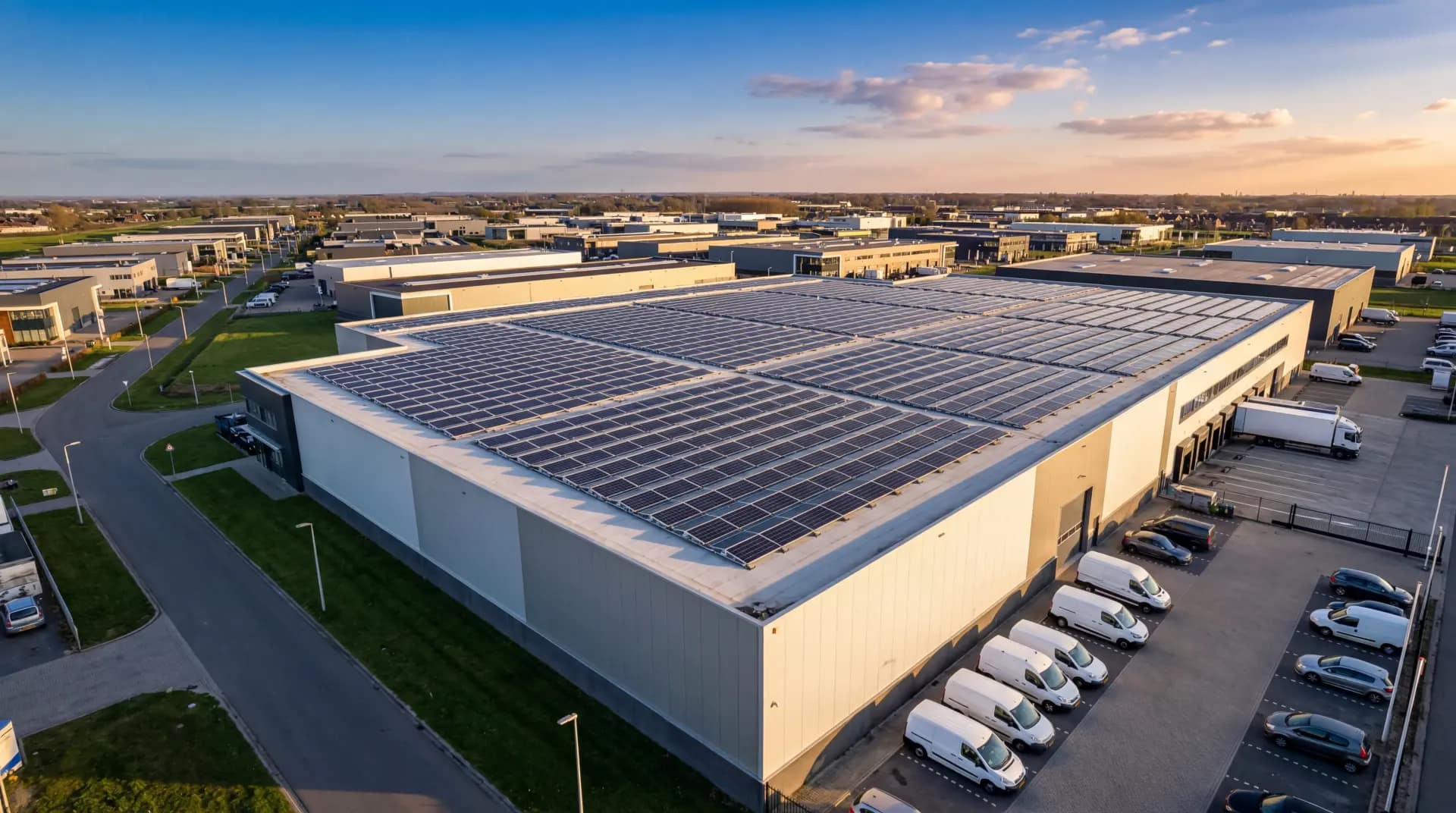
You're considering a solar project on your business premises. Or your grid operator pointed you toward the SDE++. The SDE++ (Stimulering Duurzame Energieproductie en Klimaattransitie — Stimulation of Sustainable Energy Production and Climate Transition) is the largest renewable energy subsidy scheme in the Netherlands. Budget 2026: EUR 8 billion. The scheme covers the gap between the cost price of renewable energy and the market price — for 12 to 15 years. That makes projects viable that would otherwise never get off the ground. Think commercial solar panels, battery storage, or a district heating network. On this page we explain what the SDE++ is, who it's for, how to apply, and how to combine SDE++ with EIA and Flex-E.
Inzicht in 30 seconden · Vrijblijvend
Most subsidies reduce your upfront investment costs. The SDE++ does something different: it covers operating costs. You don't get a one-off discount on the purchase price — you get an annual payment for the energy you generate or the CO2 you avoid. That payment runs for 12 to 15 years, depending on the technology. The amount is the difference between the base amount (the cost price of your technology, set by RVO) and the correction amount (the market price of energy). When energy prices are low, you receive more subsidy. When prices are high, you receive less. That makes the SDE++ a safety net: your income stays stable regardless of what the energy market does.
We calculate whether SDE++ is profitable for your project — no obligation, within 48 hours
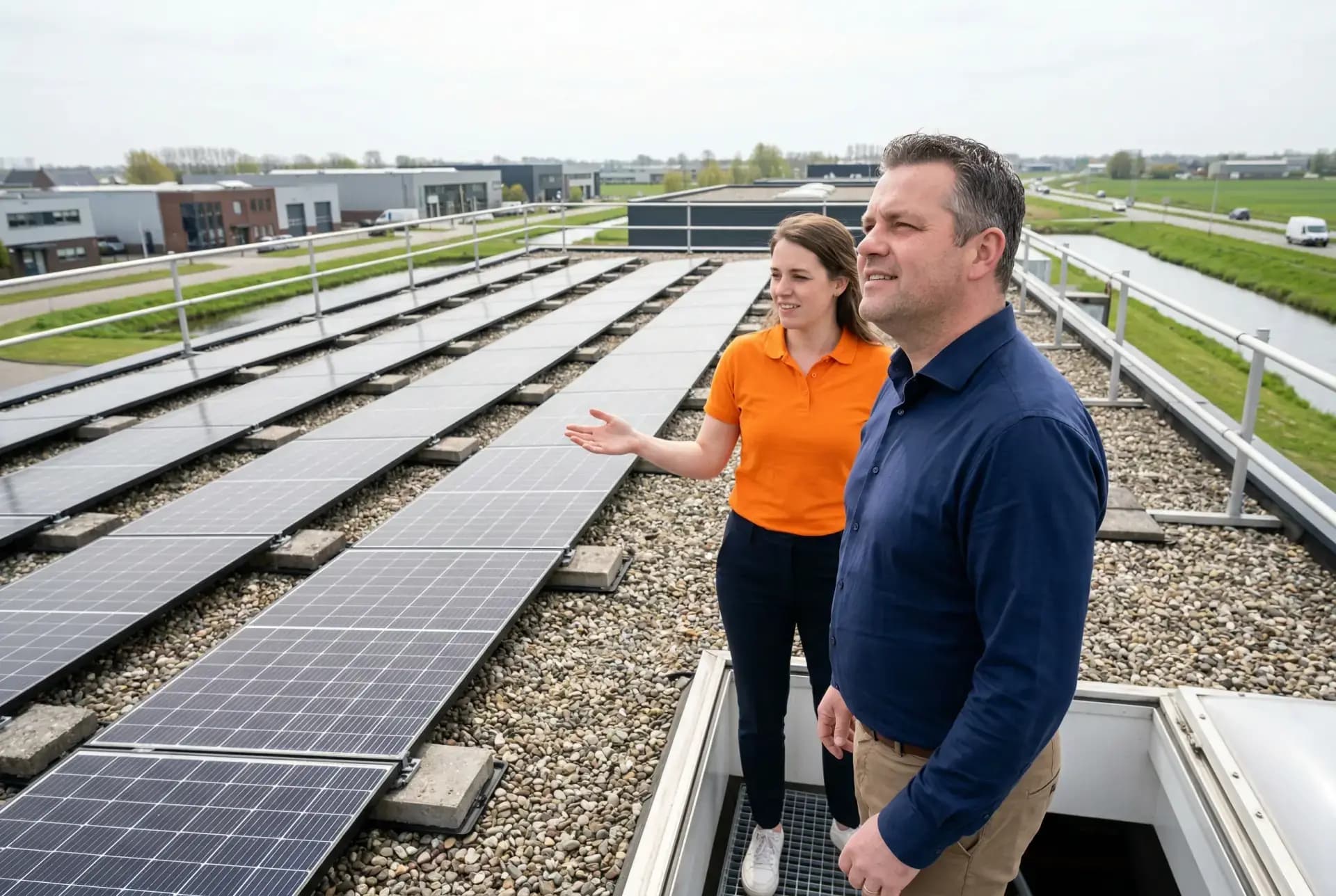
The SDE++ is designed for businesses, non-profit organisations, and public bodies that generate renewable energy or reduce CO2 emissions at scale. Private individuals are not eligible. Your project must meet a minimum size — for solar panels that's 15 kWp or more, which works out to around 35–40 panels. Most SMEs with a decent-sized roof comfortably exceed that threshold.
The SDE++ works with two figures. The base amount is the cost price per kWh or per avoided tonne of CO2 that RVO sets per technology category. The correction amount is the current market price of energy. The difference is your subsidy. For example: the base amount for your solar project is EUR 0.082 per kWh. The market price (correction amount) is EUR 0.045 per kWh. You then receive EUR 0.037 per kWh generated. With 100,000 kWh per year, that's EUR 3,700 in subsidy per year — for 15 years.
Say your SME has a commercial building with 500 m2 of usable roof space. You're considering a 100 kWp solar installation. Without subsidy the payback period is 6–8 years. With SDE++ the picture looks quite different:
Inzicht in 30 seconden · Vrijblijvend
The SDE++ is not a simple form to fill in. The application requires a feasibility study, a precise production calculation, a transportindicatie (grid connection confirmation) from your grid operator, and a permit check. Applications are ranked by cost per avoided tonne of CO2 — the lower your base amount, the better your chances. That requires strategic bidding. Most SME owners outsource this. We combine independent advice with data from extensive experience — so your phase amount is accurate and your application doesn't fall at a technical hurdle.
Inzicht in 30 seconden · Vrijblijvend
The SDE++ is the backbone of Dutch renewable energy policy. Here's what you need to know as a business owner.
Inzicht in 30 seconden · Vrijblijvend
The SDE++ budget for 2026 is EUR 8 billion, comparable to 2025. In the autumn 2025 round, nearly 3 times as much was requested as was available, according to RVO. That means selection based on price: only the cheapest projects per avoided tonne of CO2 are approved.
Depending on the technology, you receive a fixed payment for 12 years (solar panels) or 15 years (geothermal, wind, biomass). That certainty is what banks need to finance your project. The SDE++ grant decision effectively acts as a bank guarantee.
The SDE++ uses a phase system. Projects are ranked by subsidy intensity: how much subsidy per avoided tonne of CO2. Cheaper projects are approved first. That makes strategic bidding essential — bid too high and you're rejected.
The SDE++ is not a fixed amount. When energy prices are high, your payment falls (the correction amount rises). When prices are low, your payment rises. In 2022–2023 many SDE projects received little subsidy due to high energy prices. In 2024–2025 payments rose again as market prices fell.
The SDE++ covers operating costs. EIA and Flex-E cover investment costs. Combining them is allowed and strengthens your business case. The SDE++ reduces your operational risk, while EIA and Flex-E lower your upfront costs.
From idea to grant decision — these are the steps you go through. Average timeline: 4–8 months from preparation to grant.
You start with a technical design and a production calculation. For solar panels: roof survey, shading analysis, expected yield in kWh. For battery storage or heat: process analysis and energy balance. You need a feasibility study showing profitability with and without SDE++.
Your grid operator (Liander, Stedin, or Enexis) must confirm that transport capacity is available for your project. Without a transportindicatie you cannot apply for SDE++. Lead time: 4–8 weeks. In congestion areas this can take longer — start early.
Some projects require an environmental permit. The SDE++ application requires proof that permits have been applied for or granted. Note: Anteas informs you about permit requirements, but the permit application is the applicant's own responsibility.
The application round usually opens in autumn. You submit your application digitally via mijn.rvo.nl. Important: you choose a phase (base amount) for your application. The lower the base amount, the better your chances. After the round closes, all applications are ranked.
After assessment you receive a grant decision stating the approved base amount, the duration, and the completion deadline. Your project must be operational within that timeframe. For solar panels that's typically 1.5 years; for larger projects it's longer. Meeting the deadline is crucial — missing it means revocation.
Read our articles on home batteries, net metering and energy savings.
The SDE++ application itself is free at RVO. But the preparation takes time and money. You need a feasibility study, a production calculation, a transportindicatie, and possibly permits. Other parties typically charge EUR 1,750 to EUR 5,000 for comparable advice. At Anteas the energy scan is free. Because how can you sell something without first knowing what the customer needs? The full feasibility study is an investment, but often the key to a successful application. The SDE++ payment itself is not a fixed annual amount. It fluctuates with the energy market. For a 100 kWp solar project you can indicatively expect EUR 3,000–5,000 per year in SDE++ payments, for 12–15 years. The exact amount depends on your phase amount, the correction amount, and your actual production.
Inzicht in 30 seconden · Vrijblijvend
The SDE++ is not the only subsidy for renewable energy. But it is the only operating subsidy. Here's how it differs from the main investment subsidies:
| Criterion | Anteas | Others |
|---|---|---|
| Type of benefit | SDE++: operating subsidy (annual payment for energy generated, 12–15 years) | EIA: investment subsidy (one-off tax deduction of 40% on purchase costs) |
| How do you receive it? | SDE++: annual payment by RVO, based on actual production | EIA: processed in your tax return, effect at the next tax assessment |
| Who qualifies? | SDE++: businesses, non-profits, public bodies with projects from 15 kWp (solar) or equivalent | EIA: all businesses investing in assets qualifying for the Energielijst (energy list) |
| Budget 2026 | SDE++: EUR 8 billion | EIA: EUR 460 million |
| Stackable? | SDE++: yes, stackable with EIA, Flex-E, and MIA/Vamil | EIA: not with MIA, but combinable with Vamil, KIA, and SDE++ |
| Risk reduction | SDE++: reduces operational risk (guaranteed income stream for 12–15 years) | EIA: reduces investment risk (lower entry costs) |
Inzicht in 30 seconden · Vrijblijvend
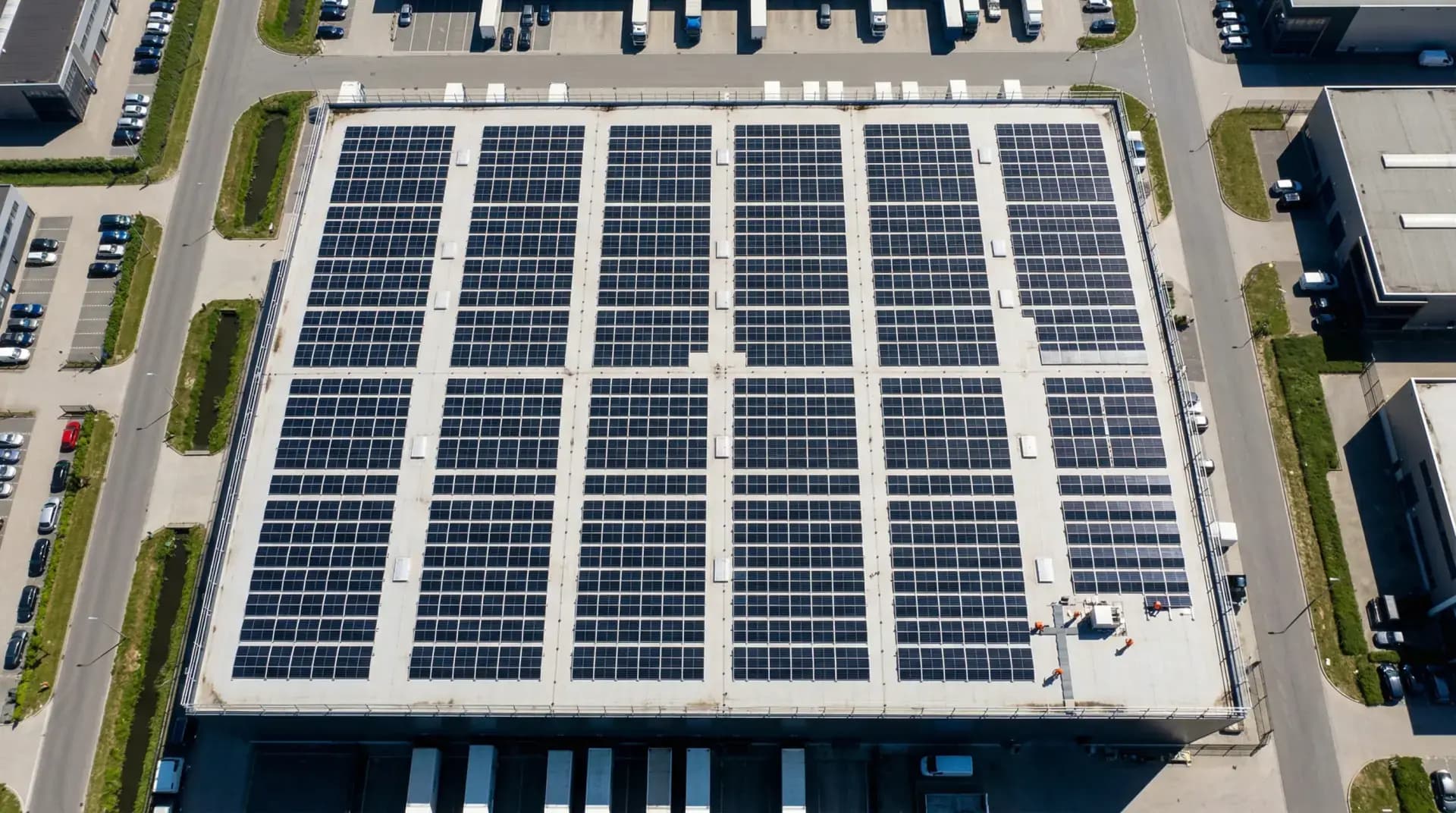
The SDE++ is broadly applicable, but not equally profitable for every project. These are the situations where the scheme makes the biggest difference:
The SDE++ is an operating subsidy. EIA, Flex-E, and MIA/Vamil are investment subsidies. Because they cover different costs, they can be stacked. The most common combination: SDE++ for operating costs plus EIA for the investment. This reduces both your upfront costs and your operational risk. Important: the SDE++ payment is not reduced if you also receive EIA. The schemes are independent of each other. As an example: a 100 kWp solar project with SDE++ plus EIA delivers indicatively EUR 3,000–5,000 per year in SDE++ payments and approximately EUR 10,000–15,000 as a one-off tax benefit through EIA. See the full subsidy overview for all stacking rules. Subsidy rules and amounts can change. Final approval is always subject to RVO's decision. Subsidy is never guaranteed.
Inzicht in 30 seconden · Vrijblijvend

Only brands we stand behind






Don't see your question here? Feel free to get in touch and we'll help you further.
An SDE++ application requires a transportindicatie from your grid operator. In areas with grid congestion (netcongestie), this can be a problem. If your grid operator cannot guarantee transport capacity, you cannot apply for SDE++ — even if your project otherwise fully qualifies. This particularly affects businesses in the Randstad region, Brabant, and Gelderland where the electricity grid is under strain. Solutions: combine your solar project with battery storage, so you feed less back to the grid. Or consider curtailment — capping part of your production in exchange for a positive transportindicatie. In our free energy scan we map out which combination — generation, storage, curtailment — works best for your grid connection and subsidy application.
The SDE++ can be the difference between a project that's 'interesting' and one that's genuinely viable. But the application is complex, competition is fierce, and strategic bidding is essential. In our free energy scan we calculate whether SDE++ fits your project, which other subsidies you can stack, and what your business case looks like with and without subsidy.
Inzicht in 30 seconden · Vrijblijvend
Laatst bijgewerkt: 5 april 2026
 Geschreven door Laurens Goeree · Energie-adviseur