Curious what you could save?
Enter your postcode and receive a no-obligation proposal within 24 hours.
Where can we help you even more?
Discover our sustainable energy services, from solar panels to commercial energy storage.

Companies with annual consumption above 50,000 kWh fall under the Dutch energy-saving obligation (energiebesparingsplicht) — a legal requirement to implement energy-saving measures (per RVO, the Netherlands Enterprise Agency). An energy management system (EMS) is the smartest way to comply — and it delivers 10 to 30% lower energy costs (per Sensorfact). Buildings with installations above 290 kW are also required to have a building automation system (BAS) under EPBD IV (the EU Energy Performance of Buildings Directive). Anteas designs, installs and monitors the entire system. More than 14,000 businesses are currently on the waiting list for a heavier grid connection (per ABN AMRO). A smart EMS solves that without the wait: shift peak consumption, store your own power, and earn revenue on the balancing market. Not as a standalone product, but as part of an integrated energy system with solar panels, energy storage and charging infrastructure.
Inzicht in 30 seconden · Vrijblijvend
Most businesses overpay for energy. Not because rates are too high, but because no one manages when energy is consumed. An energy management system changes that. It shifts consumption to cheaper hours, shaves peaks, and prevents unnecessary export at moments when the grid is saturated. In concrete terms: a manufacturing company with EUR 80,000 in annual energy costs saves EUR 12,000-24,000 per year with smart energy management. Payback period: 1-3 years (per MeterInsight). Combine an EMS with energy storage and solar panels on your premises, and you're not just managing consumption — you're controlling generation and storage from one central point. Full control over every kilowatt-hour.
Free quickscan — we calculate what an EMS will deliver for your situation

Your EMS detects consumption peaks and controls battery storage to flatten them. The result: lower capacity charges on your energy bill and less pressure on the grid. Peak shaving saves businesses with volatile consumption EUR 5,000-30,000 per year in peak charges.
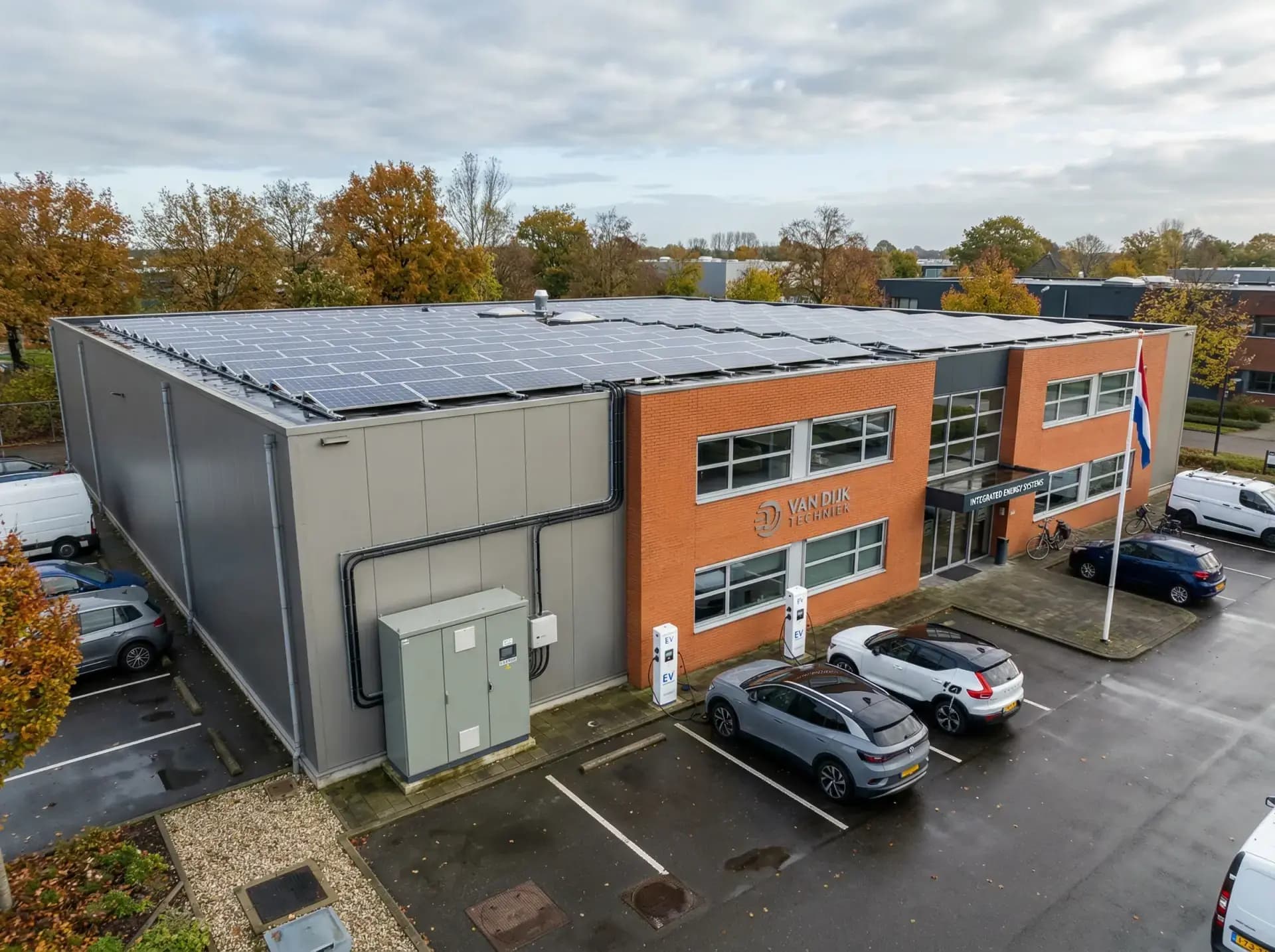
On sunny afternoons the grid is full. Without active control, your solar panels get throttled back and you lose yield. An EMS automatically adjusts your generation: store it in the battery, shift it to self-consumption, or feed it back in a controlled way when the grid allows it. No manual intervention, no wasted kilowatt-hours.
With a well-tuned energy management system you know exactly what's happening at all times. No surprises on the bill. No penalties for late reporting. And no waiting for grid capacity.
Inzicht in 30 seconden · Vrijblijvend
Most installers supply an energy management system as a standalone product. A box on the wall, an app on your phone, done. The problem: an EMS without proper design is like a sat-nav without maps. Anteas does it differently.
Inzicht in 30 seconden · Vrijblijvend
Inzicht in 30 seconden · Vrijblijvend
Other parties charge EUR 1,750 to EUR 5,000 for an energy audit. At Anteas the quickscan is free. Because how can you recommend anything without first knowing what you need? You get a documented situation assessment with conservative calculations. Not glossy spreadsheets — honest numbers your accountant can actually work with.
Solar panels from supplier A, battery from B, EMS from C, chargers from D. Sound familiar? With Anteas you have one partner for the entire energy system. One phone number. One invoice. Everything documented so you never have to explain your situation from scratch again.
Behind every Anteas installation is a dedicated team of own specialists. Our own technicians — not rotating freelancers. You notice the difference at installation, but especially afterwards: 48-hour response time, guaranteed. Our average response time is under 2 hours.
Every energy management project starts with data, not a quote. In four steps you'll know what an EMS costs, what it delivers and when it pays itself back.
We analyse your consumption profile, grid connection, existing installations and energy contracts. You receive a documented situation assessment with a conservative business case. Not a sales pitch — an analysis based on your actual data.
Based on the baseline we design an integrated energy system. Which EMS platform fits best? Do you need battery storage for peak shaving? Are your solar panels properly integrated? We choose brand-independently and explain every decision.
Our dedicated installation team carries out the work. Average lead time: 8 weeks from sign-off to handover. You have a dedicated contact who knows your file inside out. No surprises: the price after the technical survey is final.
After handover we actively monitor your system. You have real-time insight via a dashboard. Performance below forecast? We step in. We report automatically for the Dutch energy-saving obligation. And you have our direct number for questions or faults.
Read our articles on home batteries, net metering and energy savings.
The cost of a commercial EMS depends on the complexity of your installation, the number of energy flows you want to control, and whether you add battery storage. For an SME with solar panels and basic monitoring, you're starting from EUR 5,000-15,000. A fully integrated system with energy storage, peak shaving and trading optimisation costs EUR 50,000-200,000+. Payback period: 1-3 years for most configurations. That's because an EMS doesn't just cut costs — it also generates revenue through energy trading and grid services. At Anteas you receive a final price after the technical survey. If we missed something, it's on us. No extra costs afterwards. *All prices quoted are indicative and exclude VAT unless stated otherwise. The final price is determined after a personal site assessment. Subsidy rules and amounts may change. Final award is always subject to approval by RVO.*

Inzicht in 30 seconden · Vrijblijvend
You can buy an energy management system as a standalone product and manage it yourself. Or you choose a partner who handles the entire journey: from design to monitoring. Here are the facts.
| Criterion | Anteas | Others |
|---|---|---|
| Upfront situation assessment | Free quickscan with documented analysis | Standard quote based on floor area |
| System design | Integrated: EMS + generation + storage + charging | EMS as standalone product, rest arranged separately |
| Brand choice | Brand-independent based on your consumption profile | Tied to one brand or platform |
| Installation | Own technicians, 12+ brands | Rotating subcontractors |
| Price guarantee | Fixed price after technical survey | Extra costs possible afterwards |
| Post-installation monitoring | Active monitoring + 5-year Yield Guarantee | Your own responsibility or separate subscription |
| Response time for faults | 48 hours guaranteed, average 2 hours | No SLA, waiting weeks to months |
Inzicht in 30 seconden · Vrijblijvend

An energy management system isn't equally relevant for every business. But if any of these situations apply to you, it's worth exploring your options.
An energy management system only works when it controls all energy flows. Solar panels generating. Batteries storing. Chargers charging. An EMS deciding what happens when, based on price signals, grid capacity and your consumption pattern. Anteas designs that as a whole. Not as five separate products from five suppliers. One point of contact. One invoice. One team taking responsibility for the result.
Inzicht in 30 seconden · Vrijblijvend

Only brands we stand behind









Don't see your question here? Feel free to get in touch and we'll help you further.
From 1 January 2026 the new Dutch Energy Act (Energiewet) replaces the Gas Act and Electricity Act, introducing stricter reporting requirements for businesses. The energy-saving obligation (energiebesparingsplicht) already applies from 50,000 kWh/year (per RVO). EPBD IV (the EU Energy Performance of Buildings Directive) requires non-residential buildings with installations above 290 kW to have a building automation system (BAS). And from October 2027, ISO 50001 certification becomes mandatory for organisations above 85 TJ/year (per CertificeringsAdvies Nederland). Three regulations, one conclusion: smart energy management is no longer optional. Non-compliance leads to enforcement action and fines. The sooner you start, the sooner it pays off. Read more about the energy-saving obligation and what it means for your business.
Other parties charge EUR 1,750 to EUR 5,000 for an energy audit. At Anteas the quickscan is free. Because how can you recommend anything without first knowing what you need? You get a documented situation assessment with conservative calculations. No obligations.
Inzicht in 30 seconden · Vrijblijvend
Laatst bijgewerkt: 3 april 2026
 Geschreven door Laurens Goeree · Energie-adviseur