Curious what you could save?
Enter your postcode and receive a no-obligation proposal within 24 hours.
Where can we help you even more?
Discover our sustainable energy services, from solar panels to commercial energy storage.

A BESS (Battery Energy Storage System) stores electricity in lithium iron phosphate cells and delivers it back when your business needs it. From standby to full power in under a second. That makes a battery energy storage system the fastest-responding flexible capacity on the electricity grid. You shave peaks, store solar power, and trade on the imbalance market. TenneT expects the Netherlands to need 9 GW of battery capacity by 2030, while 758 MW is installed today (SolarPlaza, 2025). The market is growing. The question is not whether you get in, but when.
Inzicht in 30 seconden · Vrijblijvend
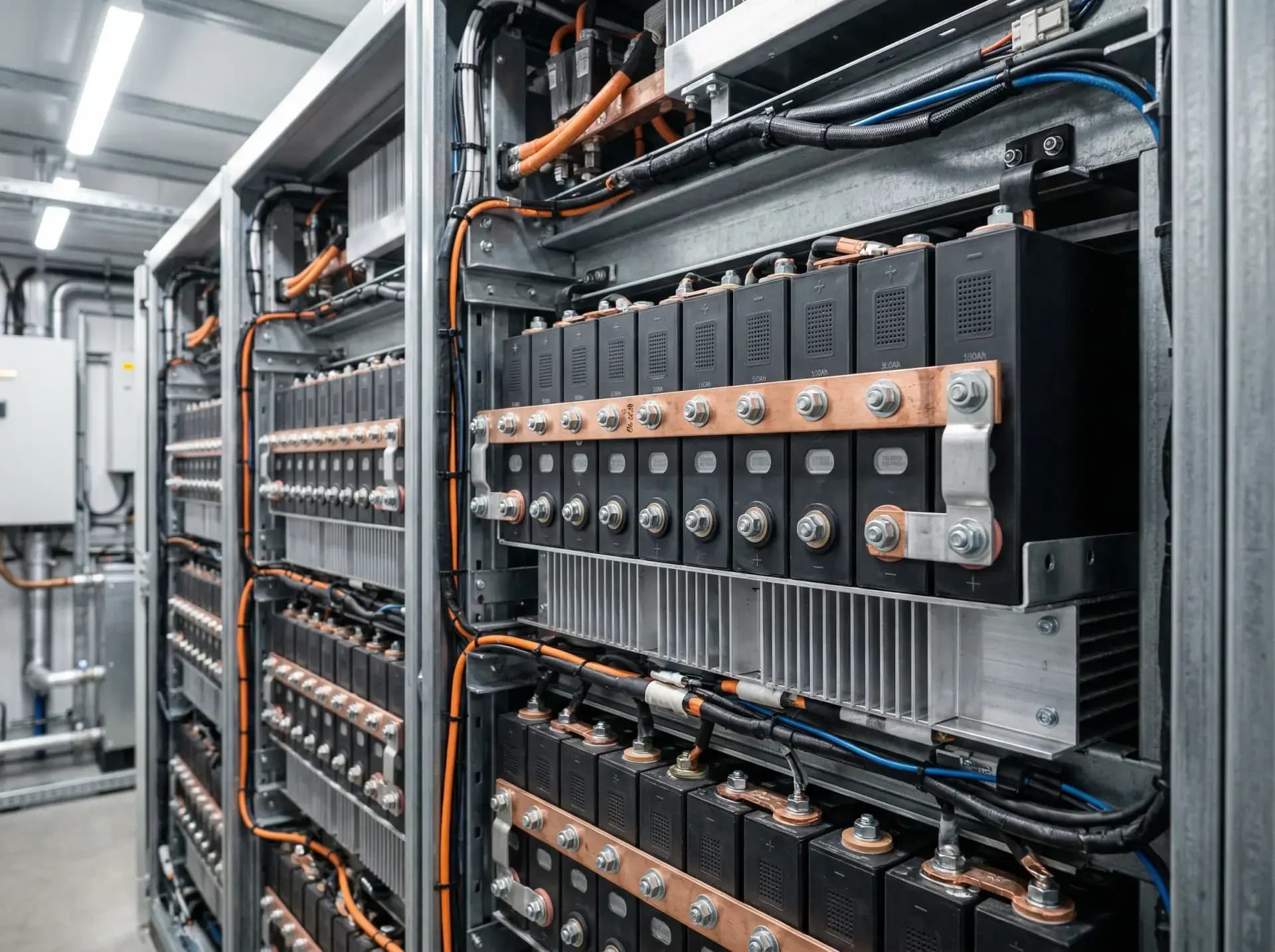
A BESS is more than a large battery. It is an integrated system of battery modules, a bidirectional inverter (PCS), a battery management system (BMS), and an energy management system (EMS). These four components work together. You store power when it is cheap or when your solar panels produce excess. And you discharge when prices are high or when your business hits a peak. The result: lower grid fees through peak shaving, higher self-consumption from your commercial solar panels, and additional income through energy trading. According to Rabobank (2025), the pros and cons of battery storage are now well documented: the technology is proven, the business case is calculable, and subsidies are available.
No-obligation quickscan: we calculate exactly what a BESS delivers for your business
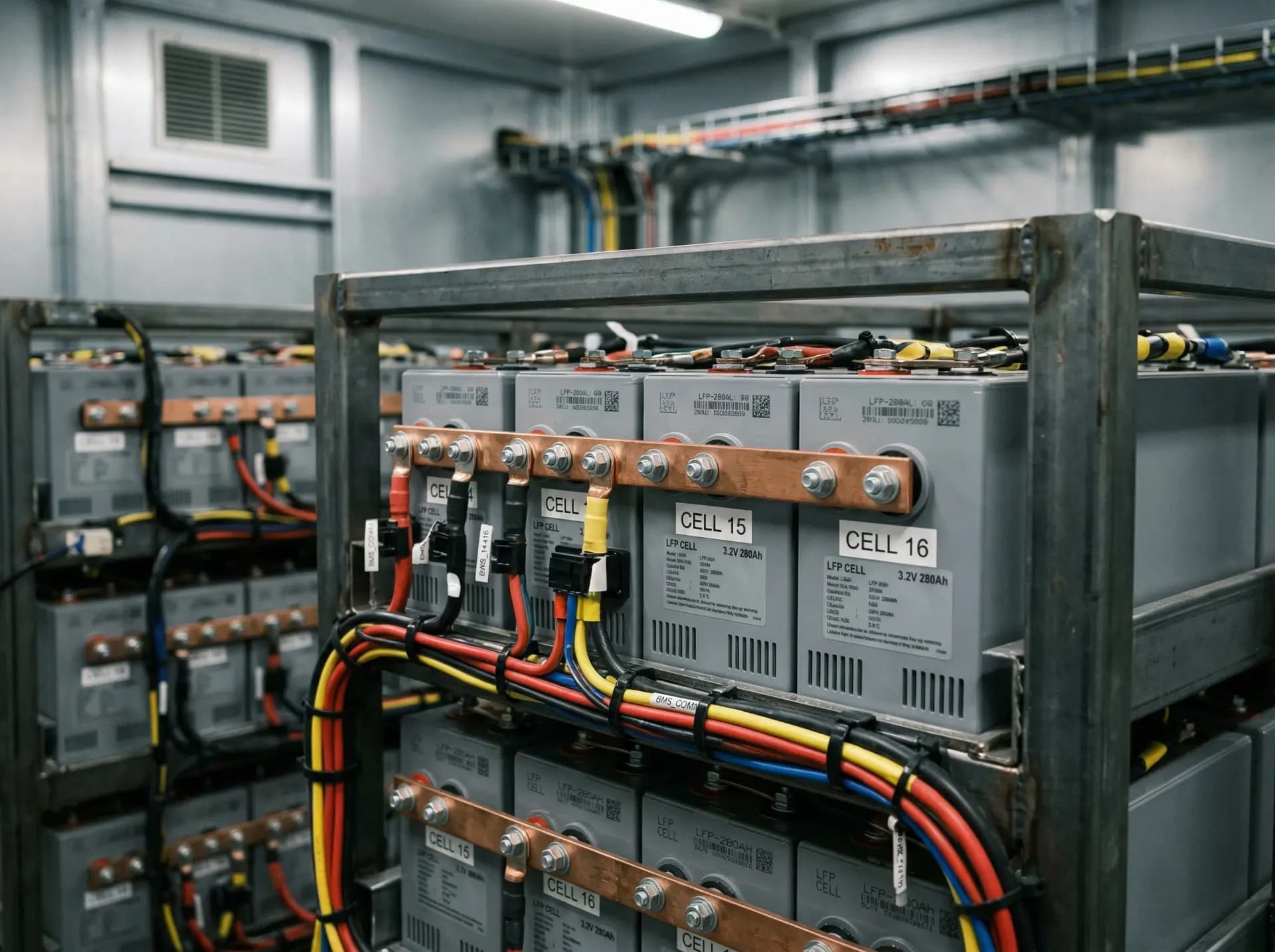
A battery energy storage system goes through three phases. In the charging phase, the system receives electricity from your solar panels, the grid, or a wind turbine. The power is stored as direct current (DC) in the battery cells. In the storage phase, the BMS monitors all parameters: current, voltage, temperature, state-of-charge (SoC) and state-of-health (SoH). In the discharge phase, the bidirectional inverter converts DC to alternating current (AC) for your business equipment.

A single income stream rarely makes a BESS profitable on its own. The power lies in stacking multiple revenue models — revenue stacking. Your EMS optimises daily which combination delivers the most. According to Synertics (2024), cross-market optimisation increases the capture price of a solar-coupled BESS by 25.46%. That is three times more than a pure arbitrage strategy.
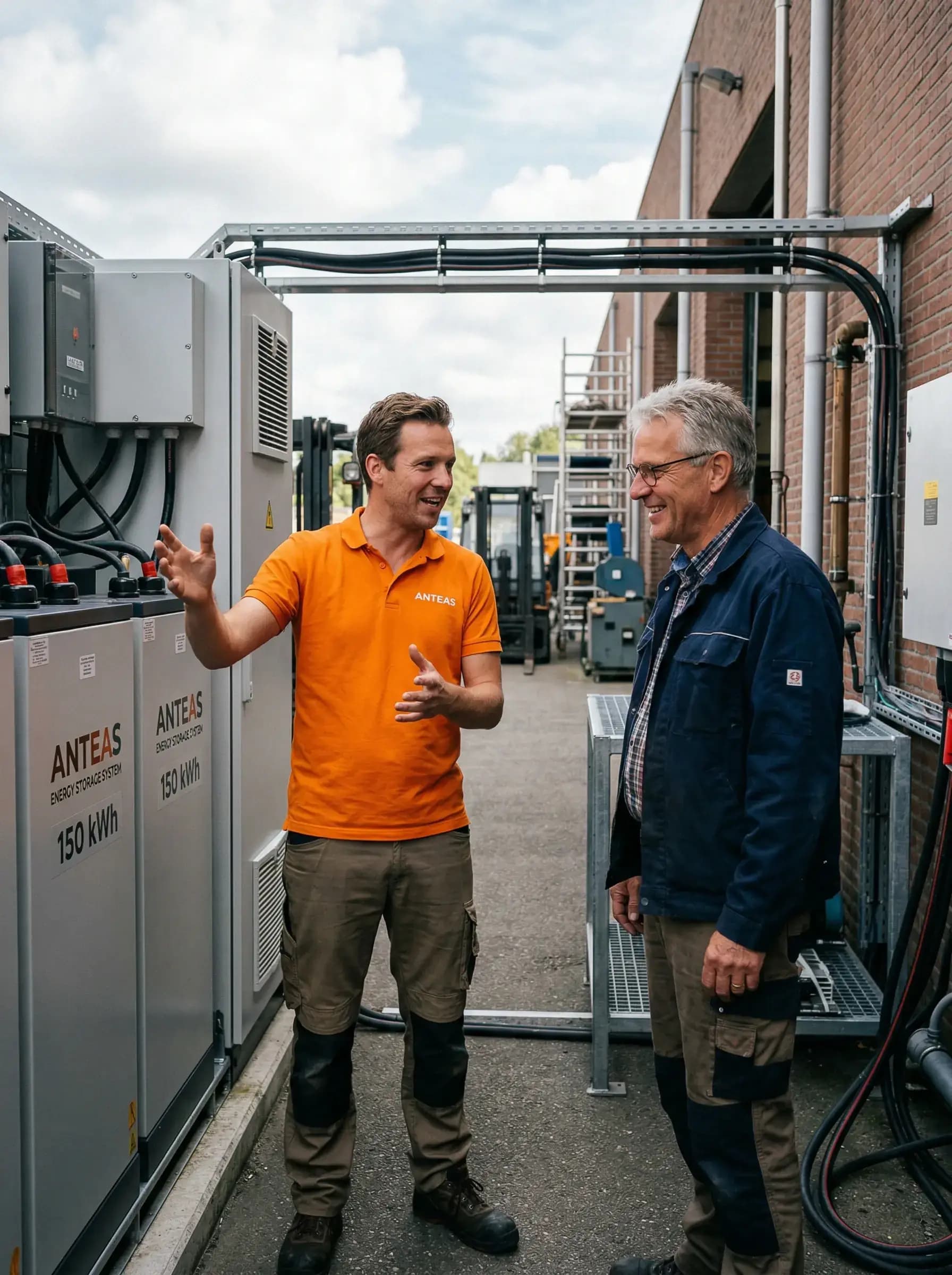
Een BESS (Battery Energy Storage System) is geen standaardproduct: elk verbruiksprofiel vraagt om een andere configuratie. Van een modulair systeem van 50 kWh tot een utility-container van meerdere MWh. Anteas adviseert merkonafhankelijk en dimensioneert op jouw piekbelasting, zelfconsumptie en groeiambitie.
Inzicht in 30 seconden · Vrijblijvend
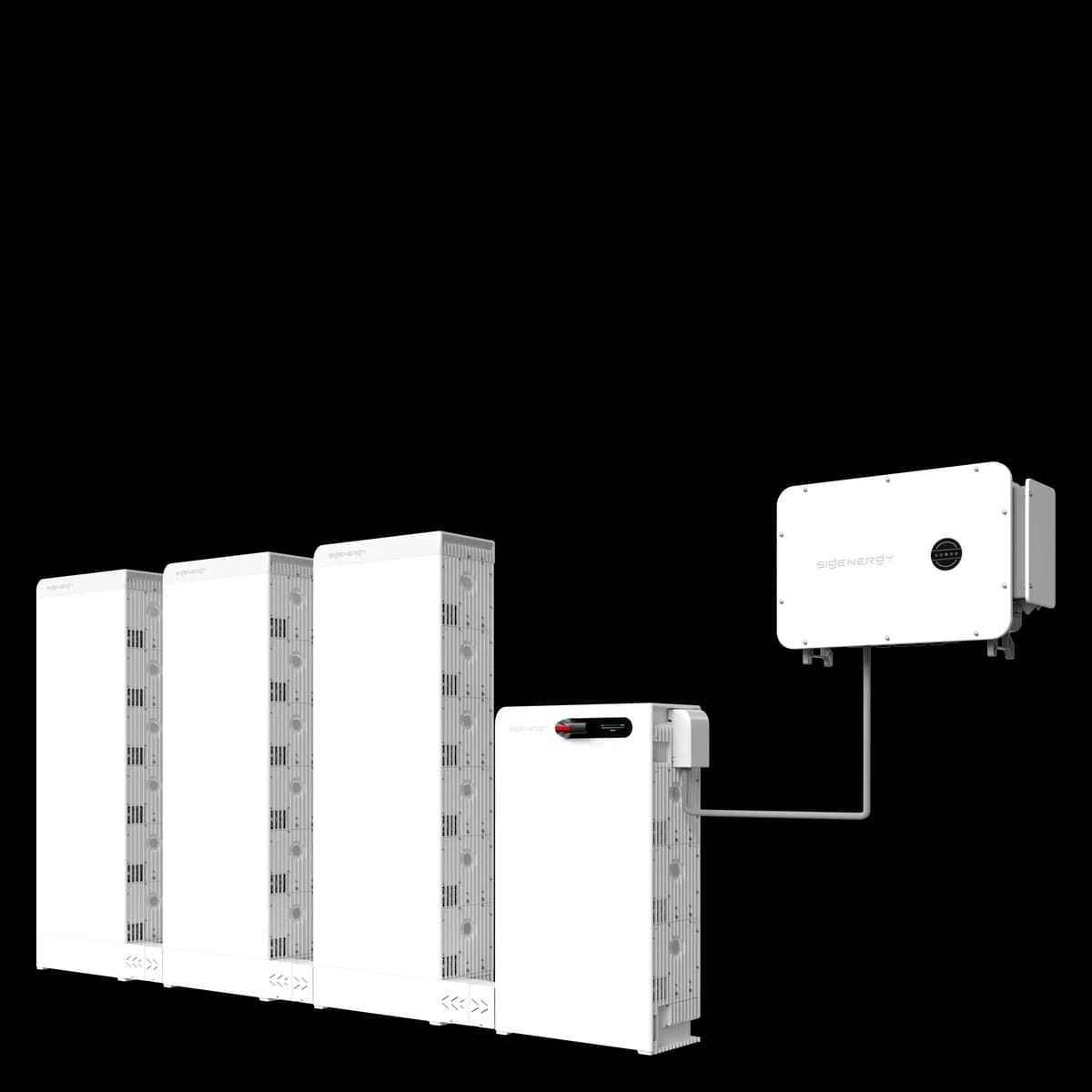
Modulair DC-gekoppeld stacksysteem voor MKB en C&I. Groeit mee met je bedrijf: begin met 50 kWh, schaal door naar 253 kWh per stack zonder extra PCS.
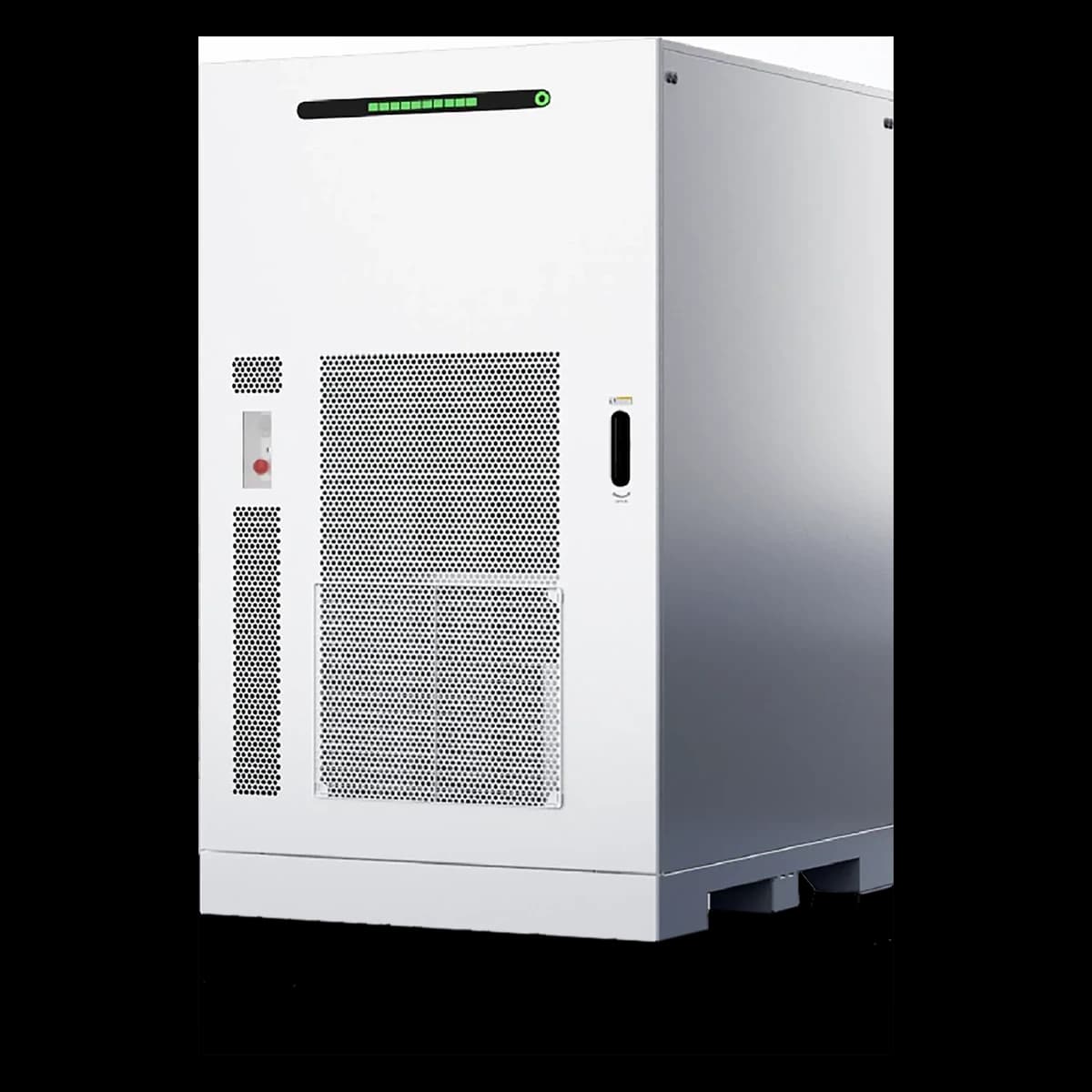
Kant-en-klare Smart String ESS-kast met 215 kWh. Pack-level optimalisatie, vloeistofgekoeld en Thermal Runaway Suppression Device (TRSD) in de Series 2. Tot 20 units parallel schakelbaar.
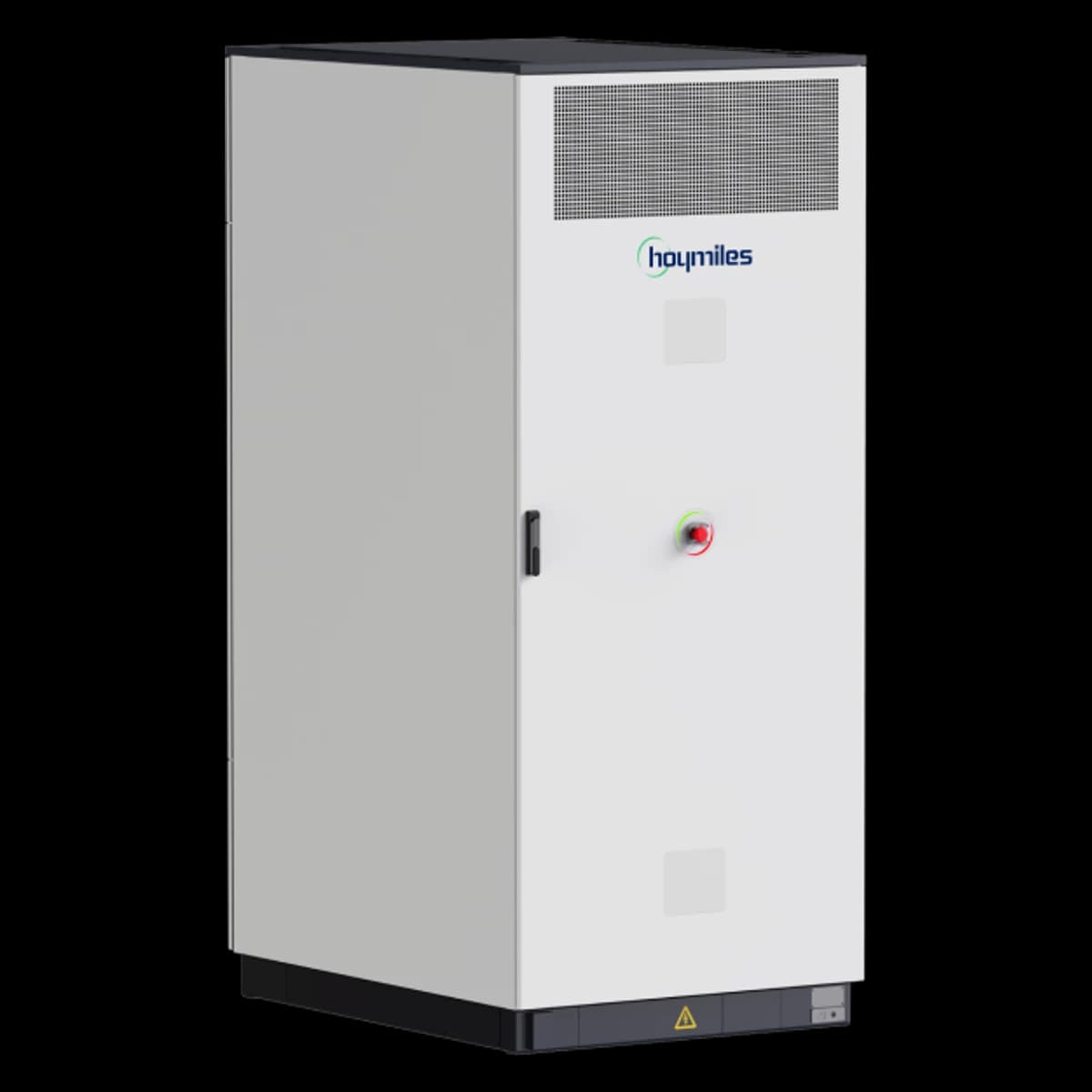
All-in-one vloeistofgekoelde C&I-cabinet met PCS, BMS, TMS en batterij in een kast. Hoge vermogensdichtheid en 15+ jaar ontwerp-levensduur, ook in zoute of stoffige omgevingen.
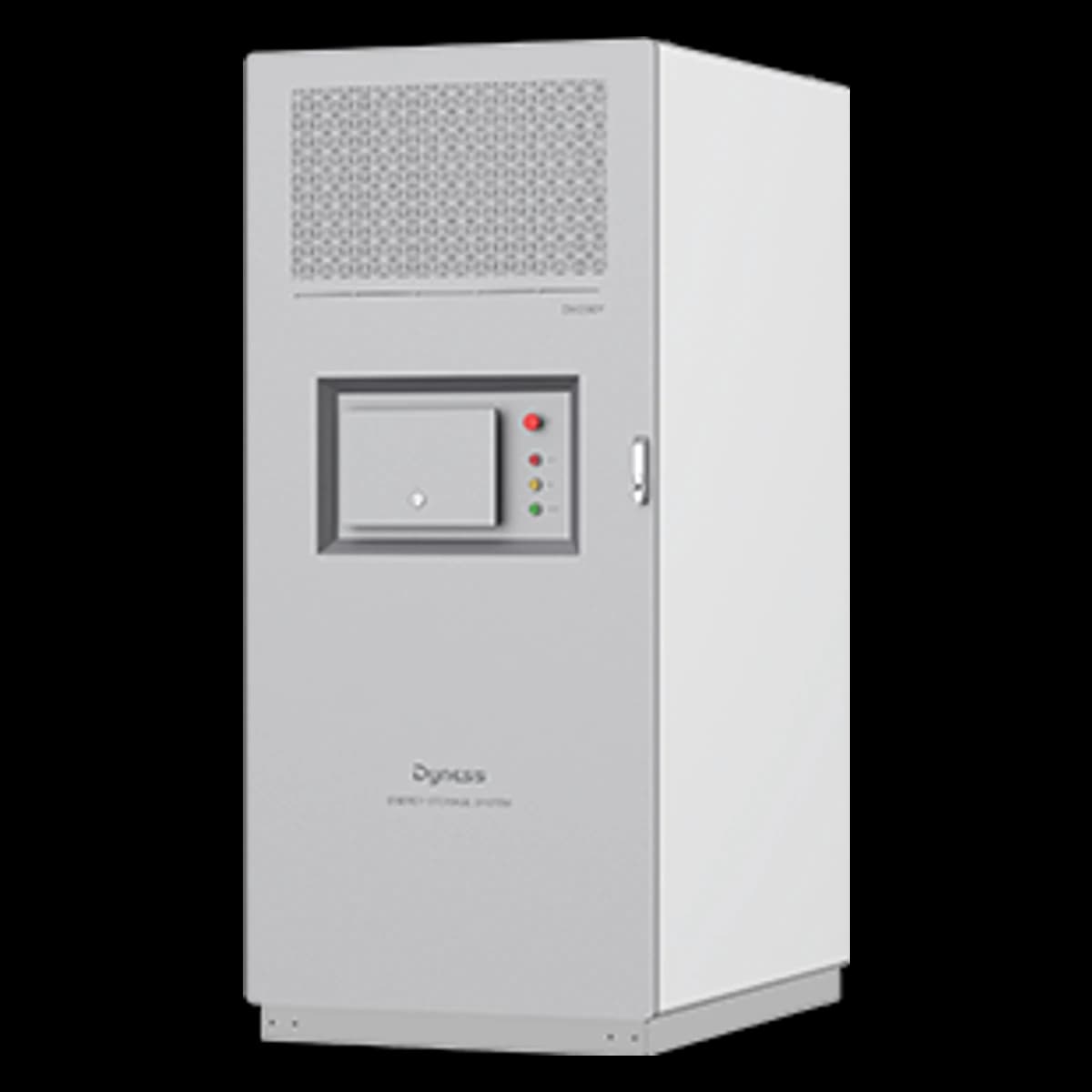
All-in-one high-voltage cabinet met vloeistofkoeling op cluster-niveau en triple-level brandbeveiliging. Compacte footprint van 1,58 m² per cabinet, uitbreidbaar tot 2,3 MWh.
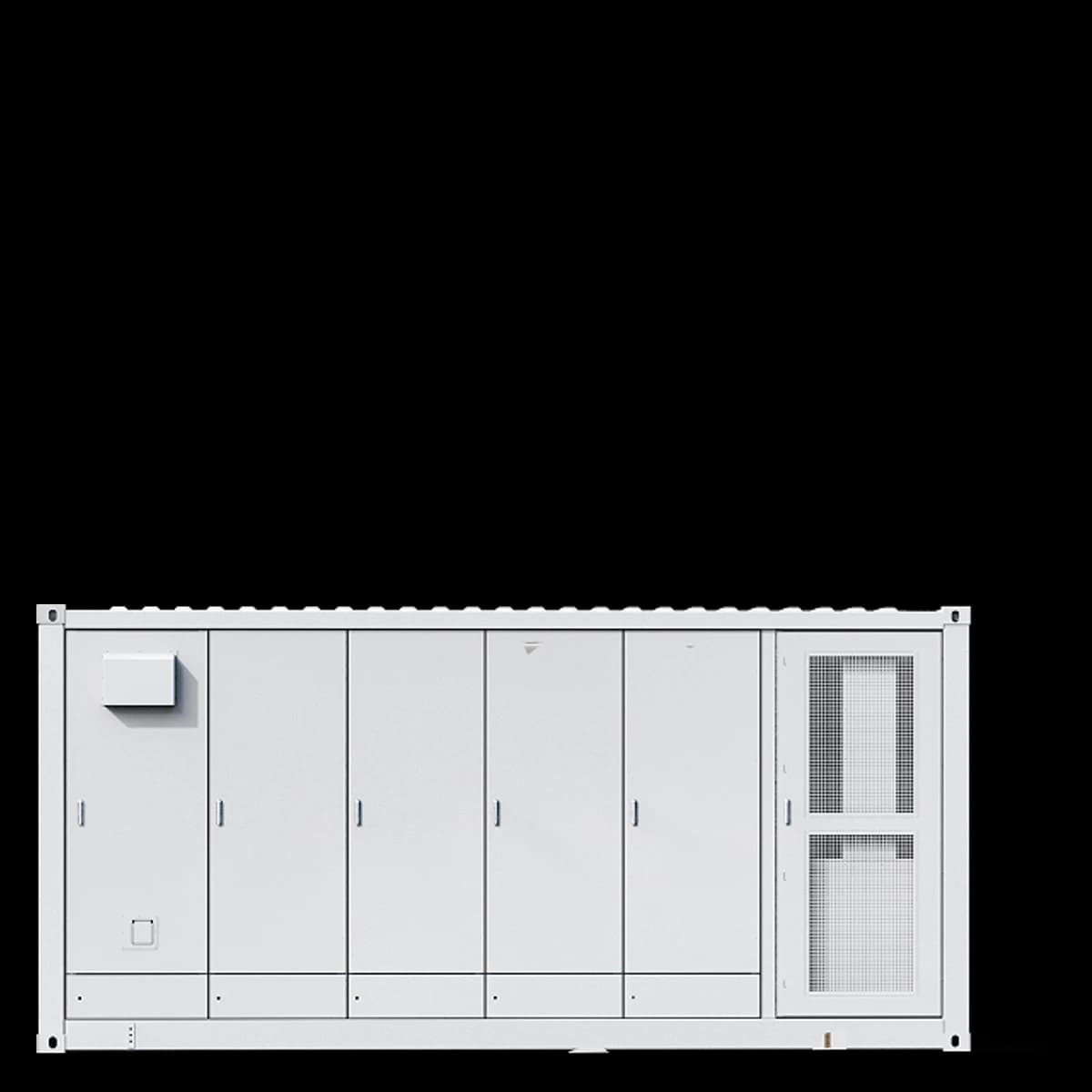
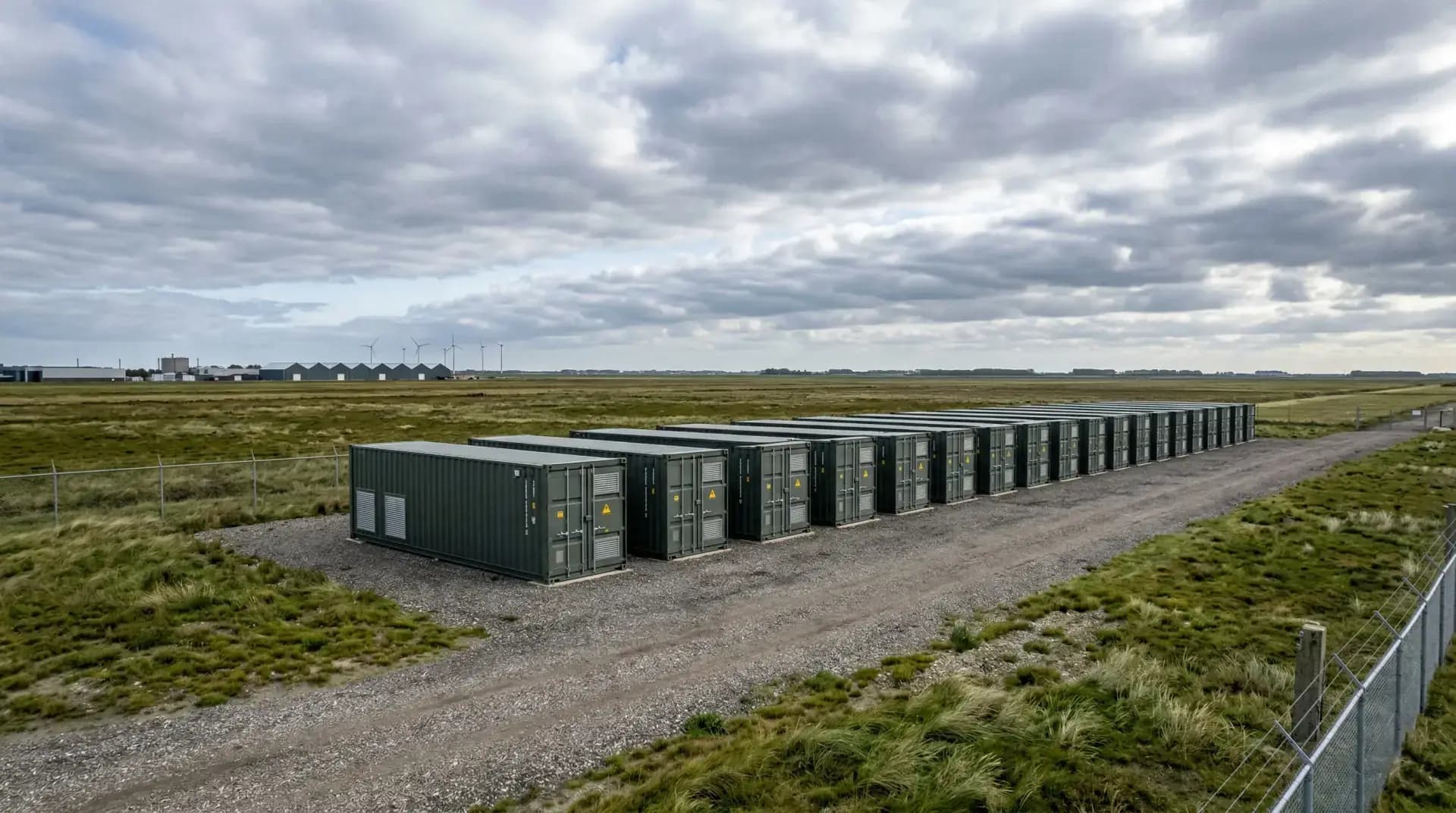
Volledig geintegreerde LFP-batterijcontainer voor grootschalige C&I- en utility-projecten. Non-walk-in design, vloeistofgekoeld en geen derating tot 45°C. Beschikbaar als 1 MW/2 MWh of 3,44 MWh.
Say you spend EUR 60,000 per year on energy. You have 200 kWp of solar panels on your roof. And your grid connection is at its limit. Here is what changes with a battery energy storage system:
Inzicht in 30 seconden · Vrijblijvend
Most installers sell the brand with the best margin. We select the system that fits your consumption profile, grid connection and growth plans. That difference shows up in the business case, the installation, and the 15 years after.
Inzicht in 30 seconden · Vrijblijvend
Not every business benefits from a BESS. But in these situations the business case is almost always positive.
Inzicht in 30 seconden · Vrijblijvend
During the day, your installation generates more power than your business needs. Without a battery you export that power back to the grid — increasingly at rates approaching zero. A BESS stores the surplus and delivers it back when you need it. Combine with your commercial solar panels for maximum return.
A large portion of your energy bill consists of transport costs based on your peak consumption. A BESS shaves those peaks: your contracted capacity drops and your transport costs drop with it. Savings: EUR 5,000–30,000 per year, depending on your consumption profile. Read more about peak shaving.
14,044 businesses are waiting for a heavier grid connection (Rabobank, 2025). A BESS solves that: you use your current connection more efficiently by flattening peaks and filling troughs. TenneT offers TDTR contracts with up to 65% discount on transport tariffs for BESS projects. See the grid congestion solutions.
With a BESS you provide flexibility to TenneT via FCR (up to EUR 9,400/MW) and aFRR (EUR 11,400–21,500/MW). Your EMS decides daily which combination of peak shaving, arbitrage and frequency regulation delivers the most. That is revenue stacking, and it is why the business case keeps getting stronger.
More and more businesses must report on CO2 emissions (CSRD). A BESS measurably reduces your scope 2 emissions: less grid power, more self-consumption. That is not greenwashing. Those are hard numbers in your annual report.
From first conversation to the moment your battery delivers power. No surprises, fixed price guarantee after the technical survey. Fully taken care of.
We analyse your consumption profile, grid connection and tariff structure. Within 48 hours you have an initial estimate of the business case, including expected savings and payback period.
A detailed analysis with conservative assumptions. Including value stacking calculation, subsidy options, TCO calculation, and comparison of battery chemistry and brands. Prepared for your accountant.
Based on the feasibility study we design the BESS. Brand-independent: we choose the battery modules, PCS and EMS that fit best. LFP as standard for safety and lifespan. Fixed price after the technical survey.
Our own specialists install the system in compliance with NEN 1010 (Dutch electrical safety standard) and PGS 37 (Dutch guideline for lithium-ion storage). Average lead time: 6–12 weeks after sign-off, depending on system size and permits.
After delivery we monitor your BESS and optimise the EMS settings. You get real-time insight into returns via your dashboard. We adjust where necessary for maximum revenue stacking.
Read our articles on home batteries, net metering and energy savings.
The investment for a commercial BESS depends on capacity, system configuration and installation complexity. Globally, costs for commercial systems are between USD 319–506 per kWh for 1 MW/2-hour setups (HighJoule, 2024). Indicative price ranges for the Dutch market in 2026: - 50–100 kWh: from EUR 50,000 - 100–250 kWh: EUR 75,000–150,000 - 250–500 kWh: EUR 150,000–300,000 - 500 kWh to 1 MWh+: custom, from EUR 250,000 With EIA (40% tax deduction — a Dutch fiscal incentive for sustainable investments) or MIA/Vamil (alternative Dutch fiscal scheme), the effective investment comes out considerably lower. The final price is guaranteed after the technical survey. Price indications exclude VAT and depend on the specific situation.
Inzicht in 30 seconden · Vrijblijvend
The two most common battery chemistries for commercial BESS systems are LFP (lithium iron phosphate) and NMC (nickel manganese cobalt). LFP is the standard for behind-the-meter commercial use. Here is why:
| Criterion | Anteas | Others |
|---|---|---|
| Safety | LFP: thermal runaway from 270°C+, minimal gas release on failure | NMC: thermal runaway from ~210°C, larger volumes of toxic gas |
| Lifespan | LFP: 6,000+ cycles (15–20 years with daily use) | NMC: 3,000–4,000 cycles (10–15 years with daily use) |
| Energy density | LFP: lower, system is physically larger | NMC: higher, more compact system possible |
| Raw material costs | LFP: cheaper materials (iron, phosphate) | NMC: more expensive materials (nickel, cobalt) |
| Permits | LFP: faster permit process due to lower risk classification | NMC: stricter PGS 37 requirements, longer permit procedures |
| Insurability | LFP: insurers classify as lower risk | NMC: higher premiums, more restrictions |
| Best suited for | LFP: behind-the-meter commercial, SME, business premises | NMC: utility-scale projects where space is scarce |
Inzicht in 30 seconden · Vrijblijvend
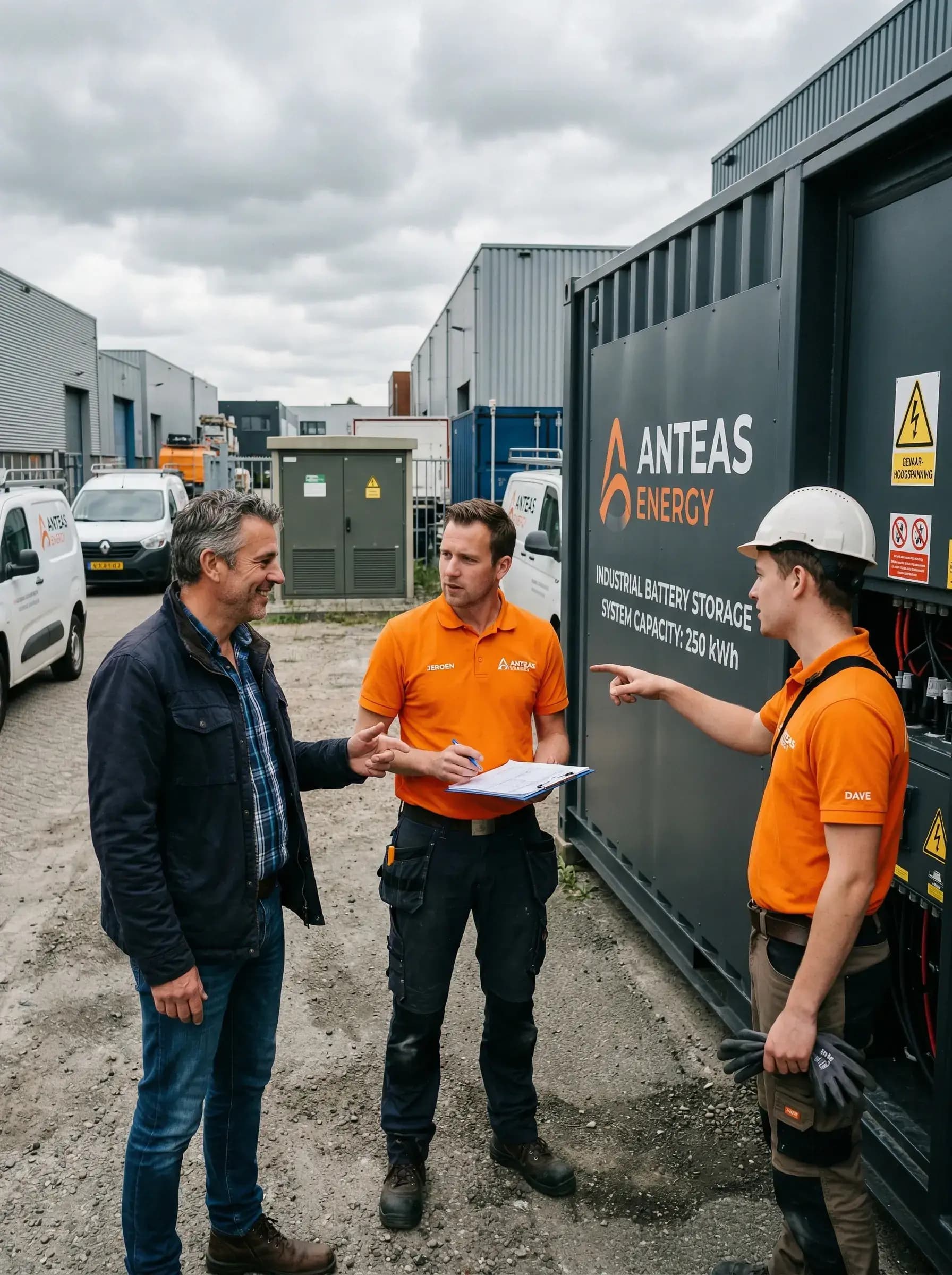
A battery energy storage system is not profitable for every business. We will tell you straight if it does not fit. But for these profiles the business case is almost always positive:
The Dutch BESS market has matured. Lion Storage has a permit for 347 MW, Giga Storage is building 300+ MW, and the government is investing EUR 100 million in solar-plus-storage subsidies (Energy Storage News, 2025). The number of flexible contract applications to TenneT exceeds 70 GW, the vast majority being battery projects. This is no longer an experiment. Businesses that get in now benefit from current subsidy budgets (EIA, MIA/Vamil, SDE++) and from falling system prices. Waiting until the market is even bigger? You can. But subsidies are finite and prices are rising again as Chinese export subsidy phase-outs kick in.
Inzicht in 30 seconden · Vrijblijvend

Only brands we stand behind








Don't see your question here? Feel free to get in touch and we'll help you further.
Commercial BESS installations must comply with NEN 1010 (electrical safety), NEN 6064 (fire safety) and PGS 37, the specific Dutch guideline for lithium-ion storage. For systems above 10,000 kg, the Bevi regulation on external safety of facilities applies. Standard safety distance: 20 metres, reducible to 8 metres within a fire compartment. Systems above 10 MW require an energy licence from the ACM (Netherlands Authority for Consumers and Markets). Anteas installs in compliance with all standards and guides the full permit process. That is not an add-on service — it is part of the project.
In a free quickscan we analyse your consumption profile, grid connection and subsidy options. You receive an initial business case with conservative assumptions, prepared to share with your accountant or CFO. No obligations, no sales pitch. Prefer to talk it through first? Schedule a call, no strings attached.
Inzicht in 30 seconden · Vrijblijvend
Laatst bijgewerkt: 8 april 2026
 Geschreven door Laurens Goeree · Energie-adviseur