Curious what you could save?
Enter your postcode and receive a no-obligation proposal within 24 hours.
Where can we help you even more?
Discover our sustainable energy services, from solar panels to commercial energy storage.

Does your business use more than 50,000 kWh of electricity or 25,000 m3 of gas per year? Then you fall under the Dutch energy savings obligation (energiebesparingsplicht). In plain terms: you're legally required to implement all energy-saving measures that pay for themselves within 5 years. Think solar panels on your business premises, LED lighting, insulation, and an energy management system. It sounds like red tape. But the reality is different. According to RVO (the Netherlands Enterprise Agency), only 15% of reporting business locations have fully met the building-related requirements. For the remaining 85%, there are measures on the table that pay for themselves within 5 years — but haven't been taken yet. That's not a compliance problem. That's losing grip on your own costs. *All threshold values and percentages are based on RVO figures (December 2025). Regulations are subject to change.*
Inzicht in 30 seconden · Vrijblijvend
The energy savings obligation isn't a cost. Every measure on the Recognised Measures List (Erkende Maatregelenlijst / EML) pays for itself within 5 years by definition — that's the legal threshold. Concretely: a production company with EUR 80,000 in annual energy costs that implements all mandatory measures can expect to save an estimated EUR 12,000–24,000 per year (indicative, based on RVO reference data and industry averages). Combine solar panels with a smart energy management system, and your energy costs drop structurally while you stay compliant at the same time. And from 2027, the payback threshold extends to 7 years — making even more measures mandatory, but also making even more savings achievable. Companies that get ahead now will reap double the rewards later. *Savings mentioned are indicative. Actual results may differ due to factors outside our control.*
Free quickscan — we calculate which measures are mandatory for your business and what they deliver
The energy savings obligation is set out in Article 5.15 of the Activities in the Living Environment Decree (Bal) and Article 3.84 of the Buildings in the Living Environment Decree (Bbl). Since 1 January 2024, it falls under the Environment and Planning Act (Omgevingswet). The core requirement: every business with annual consumption above 50,000 kWh of electricity or 25,000 m3 of natural gas per location must implement all energy-saving measures with a payback period of 5 years or less. The Recognised Measures List (EML) published by RVO contains all qualifying measures, grouped into three categories: Buildings (G), Facilities (F), and Processes (P).
There is also a reporting obligation: every 4 years you report to RVO which measures you have implemented. The most recent reporting deadline was 1 December 2025. The next round is December 2027. Large consumers using more than 10,000,000 kWh of electricity are also subject to a mandatory EED energy audit, required under the EU Energy Efficiency Directive.
The Recognised Measures List (EML) from RVO contains hundreds of measures, grouped by business type and building function. Below are the most common ones for SMEs. Each of these measures is on the EML and has a proven payback period of 5 years or less.
Inzicht in 30 seconden · Vrijblijvend
Most consultants deliver a report. We deliver a report and carry it out. From quickscan to completion to monitoring: one point of contact.
Inzicht in 30 seconden · Vrijblijvend
The energy savings obligation is getting stricter, not looser
Inzicht in 30 seconden · Vrijblijvend
Environmental authorities (omgevingsdiensten) are receiving extra funding through the SPUK THE programme for inspections and enforcement. The chance of an inspection visit is rising. A compliance order can cost EUR 750–1,500 per week or month until you comply.
The current energy savings obligation will be replaced by a broader sustainability obligation, extending the payback threshold from 5 to 7 years. More measures will become mandatory. Businesses that invest now move ahead of the curve rather than scrambling to catch up.
Commercial buildings with HVAC capacity above 70 kW have been required to have a building automation and control system (GACS) since 2026 — down from the previous threshold of 290 kW. An energy management system meets this requirement.
The EIA offers 40% tax deduction on qualifying energy investments (2026 rate). Stack it with MIA/Vamil and Flex-E for maximum benefit. The EIA list is reviewed annually. Investments that qualify now may not be on the list in 2027. *Subsidy rules and amounts are subject to change. Whether your investment qualifies depends on the current Energy List.*
Offices larger than 100 m2 must have a minimum energy label C. But energy label C does not exempt you from the energy savings obligation. Both requirements apply simultaneously. Focusing only on the label means you're missing half the picture.
From initial inventory to a fully compliant business premises. Average lead time: 4–12 weeks, depending on the scope of the measures.
We analyse your energy consumption, building type, and current installations. You'll receive an overview of which EML measures apply to your situation, including a payback calculation per measure. Other parties charge EUR 1,750 to 5,000 for this. We don't. Because how can you sell something if you don't first know what the customer actually needs?
Based on the quickscan, we draw up a measures plan — not as isolated steps, but as an integrated system: solar panels, energy storage, EMS, and insulation reinforce each other. We prioritise based on ROI and compliance urgency.
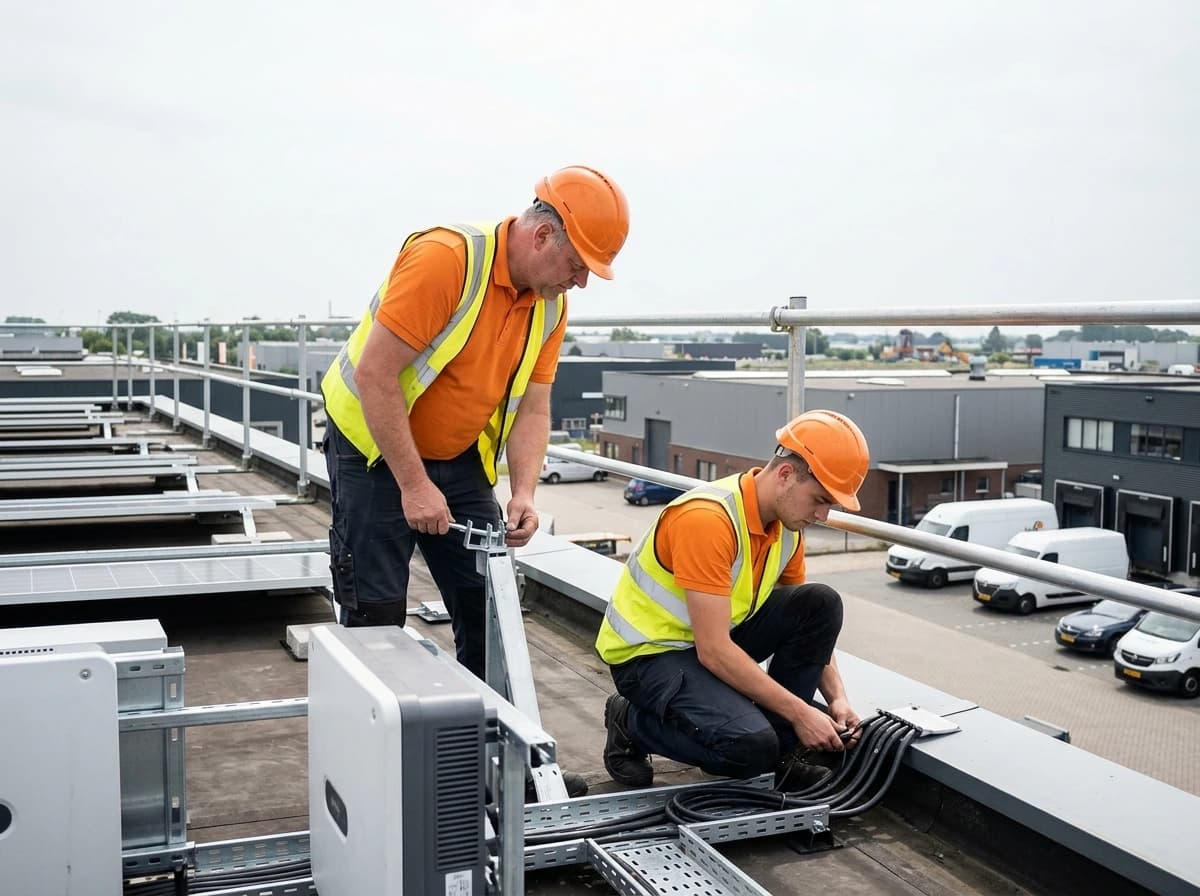
Every installation is backed by a dedicated team of own specialists. No subcontractors you don't know. One point of contact throughout the entire process. Average lead time from approval to completion: 8 weeks.
After completion, we provide the documentation you need for the reporting obligation to RVO. Our energy management system continuously monitors whether your installation is performing as per the business case. So you're also prepared for the next reporting round (December 2027).
Read our articles on home batteries, net metering and energy savings.
The Anteas Garanties (guarantees) apply to every project. Whether it's solar panels, energy storage, or a full energy management system: you know upfront what you'll pay and what it will deliver. *All prices mentioned are indicative and exclusive of VAT, unless stated otherwise. The final price is established after a personal site assessment.*
Inzicht in 30 seconden · Vrijblijvend
You can handle the energy savings obligation yourself. But the question is: do you want to? Below are the two routes side by side.
| Criterion | Anteas | Others |
|---|---|---|
| Quickscan / audit | Free — part of our standard process | EUR 1,750–5,000 with an external consultant |
| Measures plan | Integrated: all measures as a system | Per measure, in isolation |
| Installation | Own team with years of experience | Tender yourself, multiple parties |
| Point of contact | One contact person for everything | A different party for each measure |
| RVO reporting | We supply the EML documentation | Fill it in yourself via the RVO e-portal |
| Post-installation monitoring | Continuous via EMS, proactive | Track it yourself |
| Ready for 2027 tightening | Designed for the 7-year threshold | Start over when regulations change |
Inzicht in 30 seconden · Vrijblijvend

The threshold is lower than many business owners realise. An average SME with 10–50 employees can easily exceed the 50,000 kWh limit. Check below whether you're covered.
Environmental authorities are inspecting more actively than ever. Through the SPUK THE programme, they receive extra funding for oversight. The enforcement process follows steps: first a warning, then a compliance order, then a penalty notice. That penalty is typically EUR 750–1,500 per week or month, depending on the severity of the violation (based on environmental authority enforcement policy). It adds up fast — to thousands of euros. The measure you're avoiding can cost you more in three weeks of penalties than the investment itself. And you still have to implement the measure on top of that. Any way you look at it: non-compliance is more expensive than compliance. Start with a free quickscan and know where you stand within a week.
Inzicht in 30 seconden · Vrijblijvend

Only brands we stand behind









Don't see your question here? Feel free to get in touch and we'll help you further.
The current energy savings obligation is not the end of the road. The government is developing a broader sustainability obligation that takes effect in 2027. The payback threshold increases from 5 to 7 years. The scope expands to more activities and building types. And the Recognised Measures List (EML) will be updated in December 2026 with new measures. For businesses that now invest in an integrated energy system — solar panels, energy storage, EMS, and charging infrastructure — this means a head start. You're not just meeting today's requirements; you're also ready for the tightening ahead. And you're saving on your energy bill the whole time.
The quickscan is free. No obligation. No sales pitch. Just a concrete overview of which measures are mandatory, what they cost, and what they save. You'll receive an EML measures plan with a payback period per measure and available subsidies — all laid out so you and your accountant or CFO can make an informed decision. Want to talk through your situation first? That's fine too.
Inzicht in 30 seconden · Vrijblijvend
Laatst bijgewerkt: 4 april 2026
 Geschreven door Laurens Goeree · Energie-adviseur